Regenerative practices gain traction
Published 10:22 am Friday, January 23, 2026
Decades-old segment still small part of agronomy but gains momentum
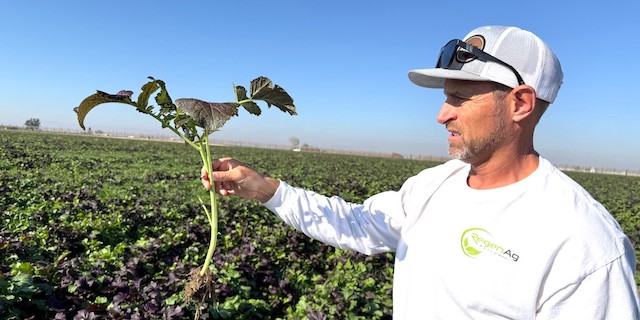
WILDER, Idaho — Tim Bryan’s cows got him into regenerative agriculture, a key driver of growth in his input supply and on-farm consulting business.
Before he and his wife, Jen, moved to southwest Idaho in 2021, they had a small hay farm and cattle operation near Ellensburg, Wash.
“We used regenerative-like practices,” Tim Bryan said.
The Bryans, now owners of Regen Ag Nation, wanted to expand their involvement with regenerative agriculture to include vegetables and hops. On moving to Idaho, they sold inputs and provided agronomic support — first as franchisees, then as owners of the independent Regen Ag.
“We saw the need to blend regenerative practices with conventional practices as a start, as a means for entry,” Tim Bryan said.
Around for decades, regenerative agriculture continues to grow but remains a small part of production agriculture’s agronomy industry.
“We are a very small rudder steering a big ship,” Bryan said.
Blended approach
Conventional inputs produce around 95% of agronomy product and service revenue industrywide, Regen Ag agronomist Trey Reid said. The future is “blending some of your regenerative fundamental practices with responsible inputs that build soils.”
Regen Ag offers conventional and regenerative products and services.
“When we blend soil health and plant health with conventional practices, we are reestablishing farmer legacy and creating a resilient system,” Bryan said. He looks at the blended approach as “using regenerative practices that make conventional systems more efficient. We are optimizing the system.”
Reid says 2026 could be a “Goldilocks” year for Regen Ag in the enterprise’s business mix and in what clients want to accomplish as most crop prices stay low and many input costs stay elevated.
“We are looking for ‘just right,’” he said. “We want to put on just the input we need to maximize output without any waste in the system.”
Some conventional ag input suppliers are getting busier on the regenerative side.
“I feel like, year to year, my sustainable and regenerative practices are increasing,” said Hayzen Corder, a Nutrien agronomist based in Parma, Idaho. “There are more conversations and there is more interest.”
While opportunities to increase these practices on a per-acre basis are increasing, the percentage is hard to quantify and varies year to year and customer to customer, he said.
Return on investment drives producer decisions, a key reason for mixing conventional and regenerative approaches, Corder said. Tariffs, product availability, and prices of inputs from chemicals to compost are on producers’ minds.
Looking ahead, he expects “a balance between where we’ve been and where we need to go to be sustainable,” he said. “The opportunity for those conversations and those practices is going to happen more frequently and continue to grow.”
Valent territory manager Alex Trudel, based in southwest Idaho, said his company is “investing heavily in the future of sustainable products. It’s definitely trending up — starting in California, then it became mainstream in tree fruit and permanent crop across Washington and Oregon.”
Sustainable products are starting to gain traction in row crops, he said. Selective insecticides that target a single insect are an example.
“Growers are starting to focus on selective chemistries to curate a specific problem” such as thrips in onions, spider mites in corn and cabbage loopers in sugar beets, Trudel said. Seven of Valent’s 13 insecticides are selective.
“We used to use non-selective insecticides and wipe out the entire population including the beneficials,” he said. “Now we’re using selective insecticides to keep things in balance.”
For Valent, sustainable products generate most of the revenue in California, and the segment’s contribution to total revenue is growing, he said. Conventional products are still used for outbreaks in Idaho and Oregon.
A sustainable product may be a bit more expensive up front but cheaper in the long term as beneficials stay alive to keep targeted pests in check, Trudel said.
“The first step in sustainability is profitability,” he said. “Growers are doing everything they can to keep the farm going. Although we can’t lose focus on sustainability and separate sustainability from prices and costs, if something is too expensive, it just won’t get adopted.”
Trudel sees “notable increases” in attendance at customer support meetings that feature stewardship training, he said.
“It’s not just about the products, but how they’re used, how they’re supported and how they fit into a whole system,” he said.
Biostimulant industry sizable
A recent expansion at Redox Bio-Nutrients headquarters in Burley, Idaho, includes a state-of-the-art lab. Redox has clients around the U.S. and internationally. Biostimulants stimulate natural processes in plants.
“The biostimulant market has seen steady growth, as more growers are interested in the latest technology to bolster plant performance, including nutrient efficiency and stress defense,” Redox president Colton Moon told Capital Press.
New comprehensive industry analysis by market research firm DunhamTrimmer “indicates biostimulants are a $4.5 billion global market, with a compound annual growth rate of nearly 10%,” he said.
For biostimulants, the biggest challenge is to deliver consistent performance with measurable, proven benefits, Moon said.
Redox — which has ISO 9001 and Fertilizer Institute certifications — puts its products through rigorous internal research and extensive third-party testing with universities and contract research organizations.
The ISO certification, from the International Organization for Standardization, “ensures controlled, consistent processes and verifies that every product contains exactly what we claim” while the Fertilizer Institute certification “further reinforces that commitment,” Moon said.
“Biostimulants are a powerful tool for successful farming, including sustainability,” he said. “When effective technology is used, we can do more with less to achieve desirable yield and quality.
“Growers deserve confidence in the products they use,” Moon said. “With so much at stake each season, relying on proven science and clearly quantified results isn’t optional— it’s essential.”
Long game
Jim Zamzow’s family owns a southwest Idaho chain of 12 lawn, garden and pet supply stores. The business dates from 1933.
Zamzow, long known for his interest in improving garden soils, in late 2018 launched Dr. JimZ. The business provides “biologically correct” fertilizer products to gardeners and farmers.
Revenue growth has been substantial from year to year, and the growth rate has been about the same in garden and agriculture segments. The ag segment remains smaller.
Compared to conventional, the agronomy industry’s regenerative segment is not getting big, but “opportunities are increasing,” Zamzow said.
Any industry-changing shift from conventional to regenerative figures to be a long haul, he said.
“It’s 50 miles into the woods and another 50 miles out,” said Zamzow, 78.
He suggests producers leave their per-acre fertilizer spending the same, divide it roughly equally between conventional and regenerative products and evaluate yearly if the regenerative percentage can be raised.
Leaving total fertilizer spending unchanged is key in that “most of these guys if they don’t make a profit this year will lose the farm,” particularly if they lease most of their ground, Zamzow said.
Farmers devoting a single-digit percentage of fertilizer spending to regenerative products is common because the regenerative side “tends to pull in a lot of really boutique products, meaning they’re really small volume,” said Dave Lister, Nampa, Idaho, plant manager and crop consultant with BioWest Ag Solutions.
“To have a sustainable, intentional approach in the regenerative category, it needs to be closer to 50-plus percent,” Lister said. “I need to make that soil way more efficient than it has been.”
BioWest blends and distributes from all four of its locations and manufactures at two — partly to keep volumes up so farmers can pay less and afford to use more.
Agronomy is moving more toward the regenerative side partly because “the cost of the conventional approach keeps increasing and we haven’t been able to match that with crop quality, yields and markets,” Lister said.
Regen Ag outlook
Bryan expects Regen Ag to grow revenue this year, with increases in consulting and acreage served.
“It really comes down to partnering with growers and increasing their net returns,” he said.
The transition to regenerative practices can feel daunting, but the right guidance helps growers “stack wins, starting with quick, low-risk adjustments like incorporating cover crops, optimizing nutrient management or shifting to softer inputs,” Reid said.
As for the regenerative industry, “for now, it’s a bit of a groundswell,” he said “It’s no longer a fad.”
Like building soils, “it’s going to take time,” Reid said.