Expert: ‘Most widespread and severe stripe rust’ since 2011
Published 10:40 am Thursday, March 5, 2026
Predictions of a severe stripe rust epidemic due to warm weather continue, USDA stripe rust expert Xianming Chen said.
In his latest forecast, Chen lowered predictions only slightly, noting that models in January’s forecast called for highly susceptible varieties to have 56.7% yield loss, based on November to December weather data. Now the models predict 55.8% yield loss. Commercially grown varieties will likely have up to 40% yield loss, or 8% yield loss on average for commercially grown varieties without fungicide application.
Chen urges farmers to check any wheat fields.
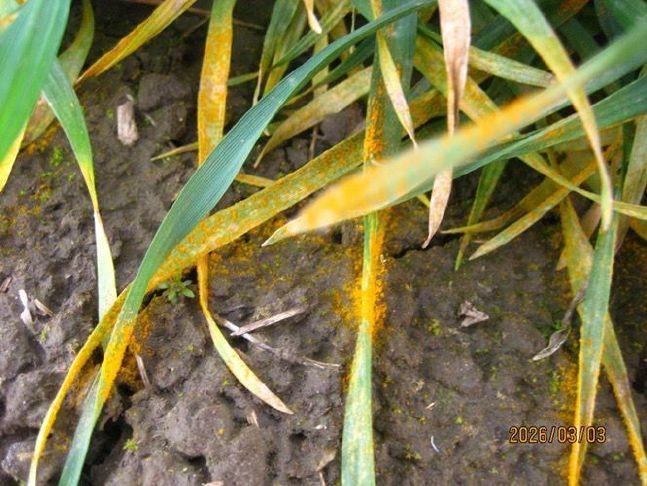
“This year, it’s very easy for growers to find rust,” he said.
If they see active rust, they should apply fungicide at the time of herbicide application. Fungicide application is recommended for moderately resistant to susceptible varieties. A second application may be needed 20 to 30 days later, if active stripe rust appears in the field after the first application.
Most wheat varieties have “quite good resistance,” Chen said.
Many have high-temperature adult plant resistance, which is effective when weather gets warm and plants reach the middle jointing stage, but not seedling resistance.
“Normally that should be fine, if rust comes normally, but that can be a problem for this year,” Chen said. “Therefore, any wheat fields should be checked for stripe rust.”
2011 comparison
“This is the most widespread and severe stripe rust by this time of year in Washington since 2011,” Chen wrote in his March outlook.
The 2010-2011 winter was the worst for stripe rust, Chen said.
That year, the lowest temperature was 17 degrees Fahrenheit. This year, the temperature did not go below 20 degrees around Pullman, Wash., Chen noted.
In 2010-2011, there were more rust infections in the fall. Chen’s team was able to find big “hot spots” at the time.
This year, he found it in more fields.
“This year, we do see widespread rust, but we did not see the big spots,” he said. “This is an indicator this rust is more shallow, uniformly.”
Rust hasn’t been found in the Palouse area, the major wheat-producing area of Eastern Washington, but Chen expects to find it in the next few weeks.
Normally, rust is found in Palouse experimental fields around the first week of May.
Field check
Chen and his associate drove 500 miles March 3 to check winter wheat fields in Whitman, Lincoln, Adams, Franklin and Walla Walla counties, and found stripe rust in all counties except for Whitman, including experimental fields near Pullman.
Rust incidence and severity were more in the south than north, correlating to temperature patterns, Chen wrote.
Most rust pustules were in the dormant stage, with few active pustules.
The team checked eight or nine fields in each county.
In Adams and Franklin counties, active pustules producing spores were found in every checked field.
In the experimental field at WSU’s dryland research station in Lind, stripe rust reached 50% incidence. Incidence was more than 80% in the experimental field in Walla Walla, with rust reaching top leaves.
Chen will check fields again in several weeks.
Based on recent years, most farmers are prepared to handle the rust, he said.
“Fungicide application is usually not a major problem for them,” Chen said. “We expect most farmers will treat their field at herbicide application time.”
In the U.S.
Stripe rust was first reported in central Washington on Jan. 15, according to Chen’s report. It was first reported in Pendleton, Ore., on Jan. 27.
It was reported in Davis, Calif., on Feb. 9, “also unusually earlier than normal.”
Stripe rust was first reported in Texas’ Hill and McLennan counties Jan. 12.
“The occurrence of stripe rust in Texas in January is an indication of severe epidemic in the southern Great Plains and potentially epidemics in the central and northern parts of the Great Plains,” Chen wrote.